
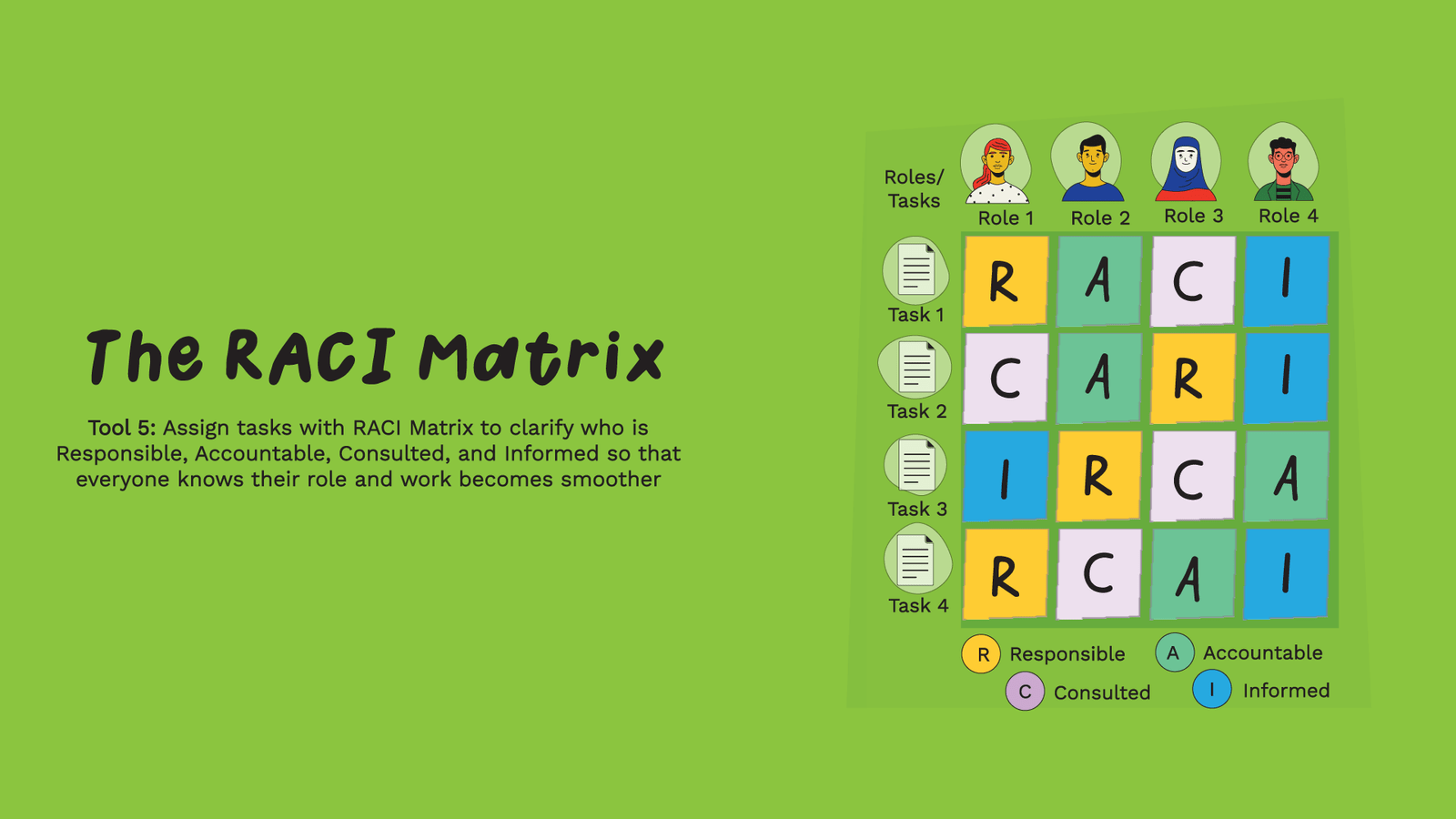
The RACI Matrix: Why Most Workplace Confusion Isn’t About Capability – It’s About Clarity
If you’ve ever been part of a meeting where everyone agreed on the plan – and yet, weeks later, nothing moved – you already understand the problem the RACI Matrix was designed to solve.
Someone assumed someone else was handling it.
Someone waited for approval that never came.
Someone did the work twice.
And someone quietly wondered, “Was that actually my job?”
This doesn’t happen because teams are careless or incompetent.
It happens because roles are often implied, not defined. Across workplaces globally – from startups to large organizations – role confusion is one of the most common, and most expensive, friction points. The RACI Matrix exists to remove that friction.
What Is the RACI Matrix?
RACI is a simple framework that clarifies who does what for a task or decision.
Each activity is assigned four possible roles:
- R – Responsible: Who does the work
- A – Accountable: Who owns the outcome and gives final approval
- C – Consulted: Who provides input or expertise
- I – Informed: Who needs to stay updated
The power of RACI is not in the letters – it’s in the conversations it forces teams to have before confusion begins.
Why RACI Matters in Real Workplaces
In theory, teams collaborate smoothly.
In reality, they operate under pressure, deadlines, and overlapping responsibilities.
RACI helps teams move from assumptions to agreements.
At work, it helps when:
- Projects stall despite everyone being “busy”
- Decisions bounce between people without ownership
- Teams feel frustrated but can’t pinpoint why
- Managers end up doing work they shouldn’t be doing
RACI creates visible accountability without micromanagement.
When roles are clear, people don’t step on each other’s work – and they don’t hesitate to take ownership either.
RACI Beyond Projects: A Tool for Personal Clarity
Interestingly, RACI isn’t only useful for formal projects.
At different points in life, people often feel overwhelmed not because there’s too much to do — but because responsibilities are blurred.
Think about:
- Career transitions
- Cross-functional roles
- Leading without authority
- Managing family, work, and personal priorities
Mentally applying RACI helps ask better questions:
- What am I truly responsible for right now?
- Where do I need alignment or approval?
- Who should I consult instead of guessing?
- What do I need to stay informed about — but not own?
Clarity reduces stress.
Ownership increases confidence.
When Should You Use the RACI Matrix?
RACI is especially useful when:
✔ Starting a new project or initiative
✔ Working across teams or departments
✔ Managing vendors or external partners
✔ Redefining roles after growth or restructuring
✔ Experiencing repeated delays or misalignment
✔ Supporting new managers or team leads
It works best when introduced early – not after things go wrong.
How to Use RACI (Simple and Practical)
- List key tasks or decisions
Focus on outcomes, not activities. - Assign one Accountable person per task
This is critical — shared accountability often means no accountability. - Clarify who is Responsible
One or more people may execute the work. - Identify who must be Consulted and Informed
Keep these groups intentional to avoid overload. - Review and agree as a team
RACI only works when it’s shared and understood.
What High-Performing Teams Understand
Strong teams don’t rely on memory, hierarchy, or goodwill alone.
They rely on clear systems that support people.
The RACI Matrix doesn’t reduce collaboration – it strengthens it.
It doesn’t limit ownership – it defines it.
And it doesn’t add bureaucracy – it removes friction.
When people know where they stand, they show up stronger.
Looking to build teams that execute with clarity, accountability, and confidence?
Pro-edge’s Management & HR Consultancy services help organizations design role clarity frameworks that actually work – in real workplaces, with real people. Visit Management & HR Consulting for your next step.



Leave A Comment