
Root Cause Analysis: Fixing the Problem Beneath the Problem
Why smart teams stop treating symptoms and start asking better questions
Most workplace problems don’t announce themselves clearly. They show up as:
- missed deadlines
- repeated errors
- rising customer complaints
- low engagement
- rework that feels never-ending
And often, the response is immediate but shallow:
“Let’s work harder.”
“Let’s remind people again.”
“Let’s add another approval step.”
The problem looks solved. But a few weeks later, it’s back — sometimes worse.
This is where Root Cause Analysis (RCA) becomes essential.
From Pareto to Root Cause: The Natural Next Step
As a pre-step, many teams use the Pareto Principle (80/20 rule) to identify where most problems are coming from.
For example:
- 80% of delays come from 3 types of issues
- 80% of defects come from 2 process steps
That’s powerful – but incomplete.
Pareto tells you where to focus.
Root Cause Analysis tells you what to fix. Without RCA, teams risk fixing the loudest problem instead of the real one.
What Is Root Cause Analysis (RCA)?
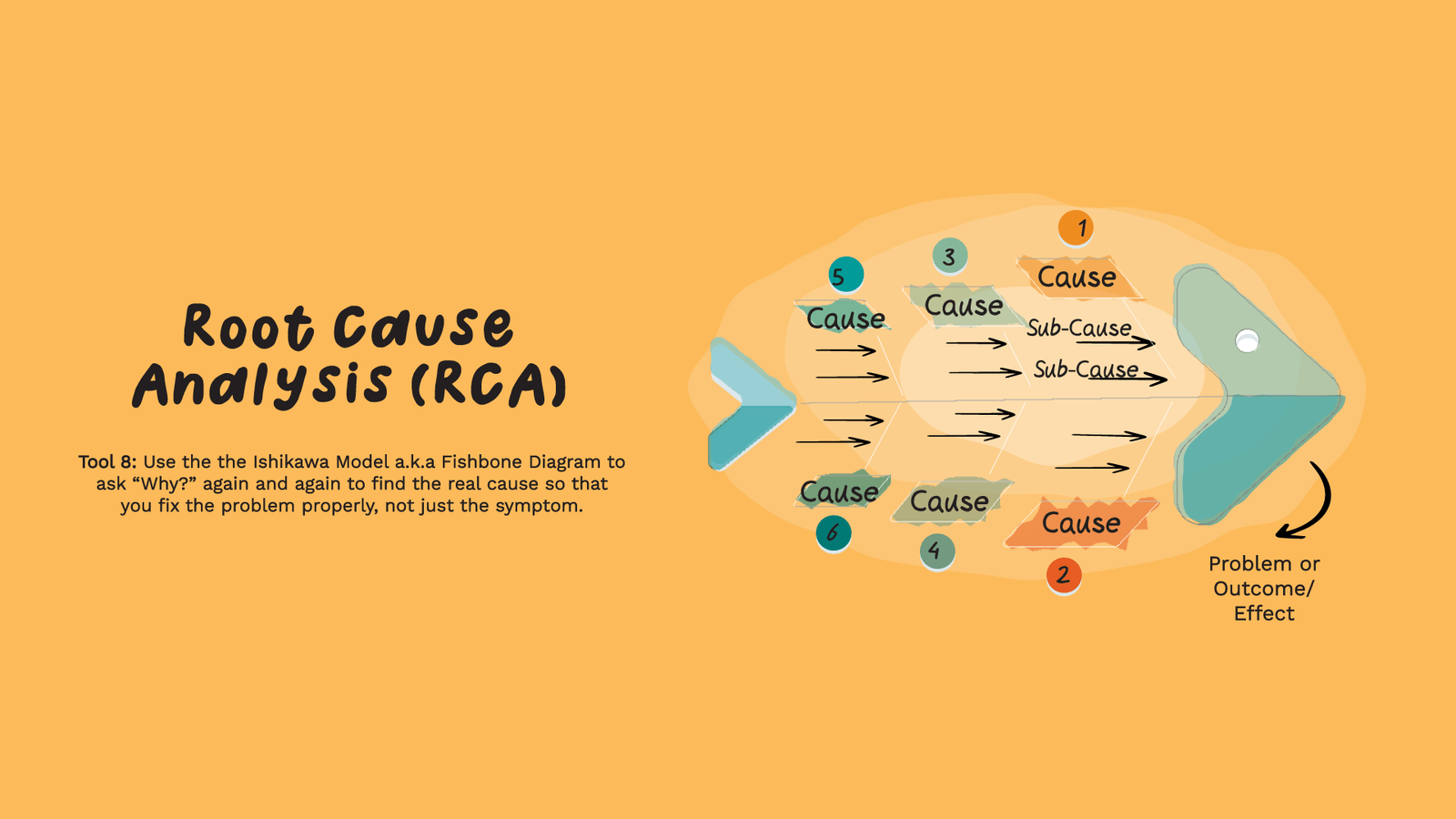
Root Cause Analysis is a structured way to identify the underlying causes of a problem – not just its visible symptoms. One of the most widely used RCA tools globally is the Ishikawa Diagram, also known as the Fishbone Diagram.
Instead of asking: “Who made the mistake?”
It asks:
“What in the system allowed this to happen?”
That shift alone changes team culture.
The Ishikawa (Fishbone) Model – In Simple Terms
You start with the problem statement at the “head” of the fish.
Then you explore possible causes across key categories, often including:
- People (skills, workload, communication)
- Process (steps, handoffs, approvals)
- Tools / Technology (systems, equipment, software)
- Materials / Information (inputs, data quality)
- Environment (time pressure, workspace, context)
- Policies / Management (rules, incentives, decisions)
Each “bone” forces the team to think broadly — and fairly.
The goal is not to blame.
The goal is to understand.
Why RCA Matters in Real Workplaces
Across industries and countries, teams that use RCA well tend to:
- reduce repeat problems
- make better improvement decisions
- build psychological safety
- save time and resources
- improve quality and consistency
RCA is especially useful when:
- the same issue keeps recurring
- quick fixes haven’t worked
- multiple teams are involved
- emotions are running high
- accountability feels unclear
It brings structure to complexity.
How to Use the Ishikawa Model (Practical Steps)
- Define the problem clearly
Be specific. “Delays in client delivery” is better than “poor performance.” - Assemble the right people
Include those closest to the work — not just decision-makers. - Map causes across categories
Ask “why might this be happening?” under each category. - Dig deeper
For each cause, ask “why?” again. Avoid stopping too early. - Identify true root causes
Look for causes that, if fixed, would prevent recurrence. - Decide actions
Focus on system improvements, not individual fixes.
A Subtle but Powerful Shift
When teams adopt Root Cause Analysis, something important changes.
Conversations move from:
“Who failed?” to “What failed in the system?”
That shift builds trust. Trust enables honesty. Honesty enables improvement.
Closing Thought
If Pareto helps you choose where to look, Root Cause Analysis helps you decide where to act.
And meaningful improvement only happens when teams are willing to look beneath the surface.If your organization is ready to stop firefighting and start fixing problems for good, Pro-edge’s specialized solutions can help you build structured, people-centered improvement practices that last. Visit Specialized Services to learn more!



Leave A Comment