
Stakeholder Mapping: Why Some Projects Move Smoothly and Others Feel Like Constant Resistance
Almost every project starts with optimism.
The plan is solid.
The timeline looks realistic.
The partners seem aligned.
And yet, somewhere along the way, things slow down.
Approvals get delayed. Vendors don’t respond on time. Key people suddenly push back. Decisions that felt “simple” become complicated.
When this happens, the issue is rarely technical. More often, it’s relational.
Not all stakeholders have the same influence. Not all vendors have the same priorities.
And not all voices need the same level of attention. This is exactly where a Stakeholder Map, based on the Power–Interest Matrix – becomes essential.
What Is a Stakeholder / Vendor Map (Power–Interest Matrix)?
At its core, this tool helps you answer four very practical questions:
- Who can influence this work?
- Who is directly affected by it?
- Who needs to be closely managed?
- Who simply needs to be kept informed?
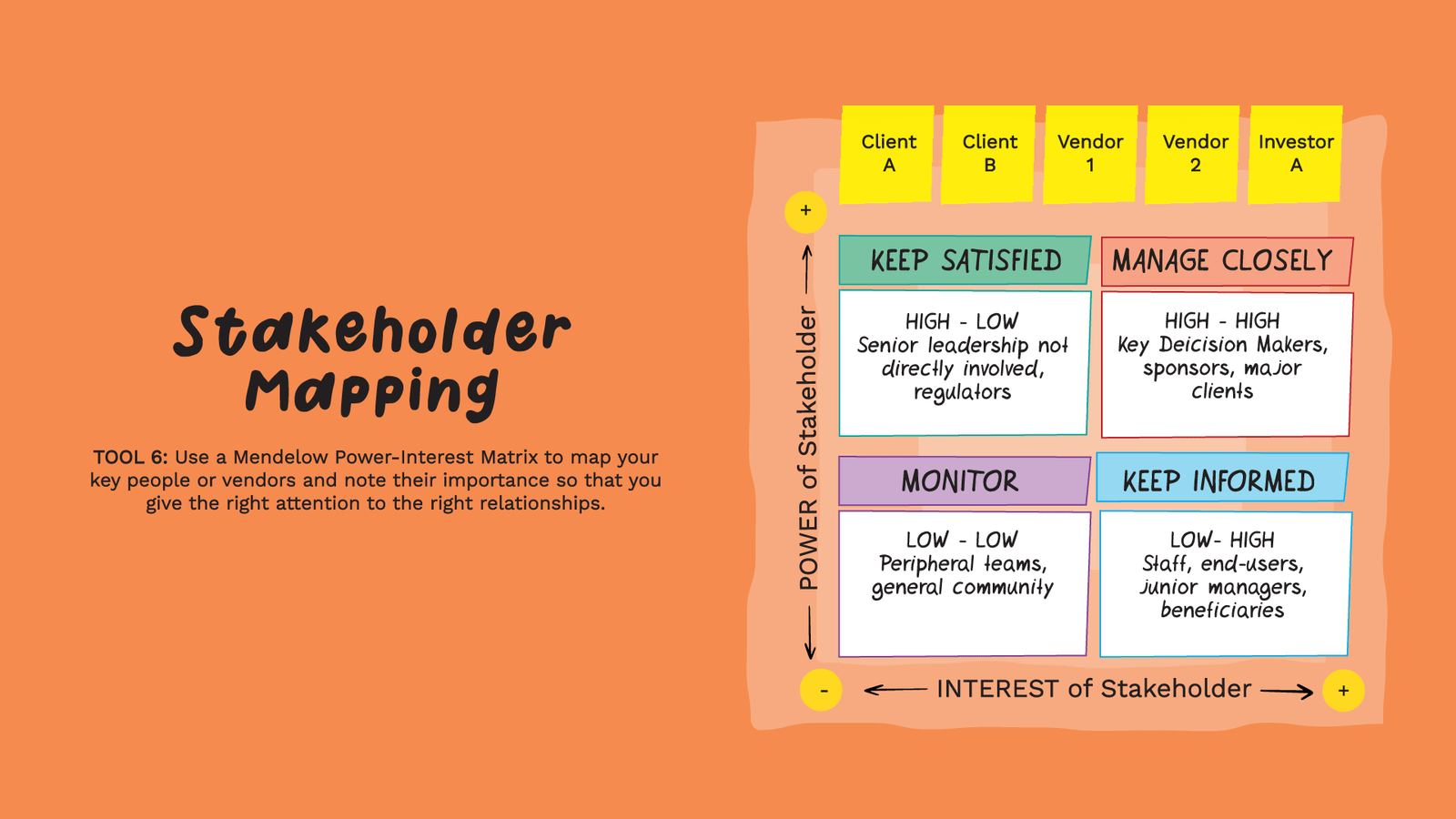
The Power–Interest Matrix plots stakeholders or vendors across two dimensions:
- Power – their ability to influence decisions or outcomes
- Interest – how invested they are in the work or results
This creates four clear groups:
- High Power, High Interest : Manage closely
- High Power, Low Interest : Keep satisfied
- Low Power, High Interest : Keep informed
- Low Power, Low Interest : Monitor with minimal effort
It’s simple – but it fundamentally changes how you allocate attention, time, and energy.
Why This Tool Matters (At Work and Beyond)
In the workplace
Global teams today operate within complex ecosystems: internal departments, external vendors, regulators, consultants, partners, and clients.
Without stakeholder mapping:
- decisions get stalled
- communication becomes reactive
- energy is spent managing the wrong expectations
With a clear map:
- engagement becomes intentional
- risks are anticipated
- relationships are managed proactively
This is especially critical when working across borders, cultures, and organizational hierarchies.
In personal and career decision-making
Surprisingly, this tool works beyond formal projects.
Think about:
- a career transition
- starting a business
- pursuing further education
- relocating
- managing family or community commitments
You are still navigating stakeholders:
- mentors
- decision-makers
- dependents
- collaborators
- gatekeepers
Mapping who has influence – and who truly is invested – helps you move forward with clarity instead of friction.
A Quiet Shift That Makes a Big Difference
Teams that use stakeholder maps don’t become louder. They become calmer.
They stop over-communicating with people who don’t need it. They stop under-communicating with people who matter most. They replace assumptions with structure.
This is not about power politics. It’s about respecting influence and attention as limited resources.
When Should You Use a Stakeholder / Vendor Map?
Use this tool when:
- Launching a new project or partnership
- Onboarding new vendors or suppliers
- Managing cross-functional initiatives
- Facing resistance or slow approvals
- Expanding into new markets or services
- Planning long-term strategic initiatives
If a project feels “stuck,” this tool often reveals why.
How to Use the Power–Interest Matrix (Simple Steps)
- List all stakeholders or vendors
Internal and external – be thorough. - Assess power honestly
Who can block, approve, influence, or accelerate outcomes? - Assess interest realistically
Who truly cares about the results – not just formally, but practically? - Place each name in the matrix
One quadrant at a time. - Define engagement strategies
- Manage closely
- Keep satisfied
- Keep informed
- Monitor
Review as conditions change
Power and interest shift over time – your map should too.
What This Tool Ultimately Teaches
Not every relationship needs the same intensity.
Not every voice needs the same volume.
And not every stakeholder needs the same strategy.
Progress accelerates when attention is aligned with influence.
That’s true for projects.
It’s true for partnerships.
And it’s true for life decisions.If you’re working within complex ecosystems – suppliers, partners, teams, or institutions – clarity is your strongest advantage.
Explore how Pro-edge and Poshora help you connect you with reliable vendors and structured solutions that support smarter, more strategic collaboration. Visit Poshora Services to learn more!



Leave A Comment