
The Balanced Scorecard – Seeing the Full Picture, Not Just the Numbers
There’s a familiar situation that many organizations and individuals find themselves in.
The numbers look good.
Revenue is growing. Costs are under control. Targets are being hit.
And yet, something feels… off.
Teams feel stretched.
Customers seem less loyal.
Learning slows down.
Processes feel fragile instead of resilient.
This is where many leaders pause and ask an important question:
“Are we performing well — or just measuring what’s easy?”
The Balanced Scorecard exists precisely to answer that question.
What Is the Balanced Scorecard?
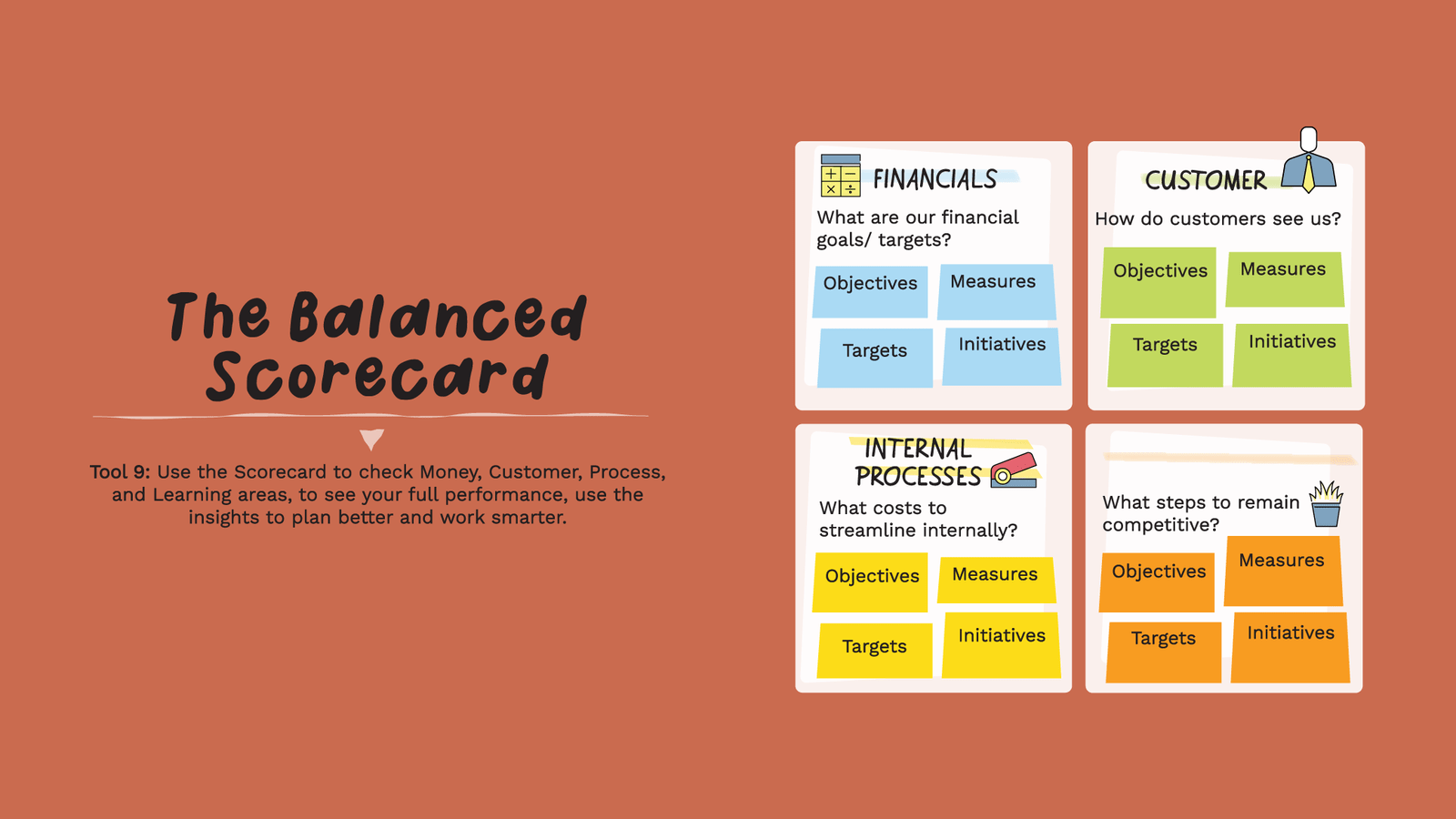
The Balanced Scorecard is a strategic framework that helps you look at performance from four connected perspectives, instead of relying only on financial results:
- Financial: Are we delivering value sustainably?
- Customer / Stakeholder: Are we meeting real needs and expectations?
- Internal Processes: Are our systems efficient and reliable?
- Learning & Growth: Are we building future capability?
Together, these perspectives offer a more complete view of success – one that balances today’s outcomes with tomorrow’s readiness.
Why This Tool Matters (At Work and Beyond)
In organizations
Across industries and regions, many businesses struggle not because of poor strategy, but because of narrow measurement. Financial metrics tell you what happened, but not why – or what’s coming next.
The Balanced Scorecard helps leaders:
- align teams around shared priorities
- connect daily work to long-term strategy
- avoid short-term wins that create long-term problems
- make performance conversations clearer and fairer
It turns strategy from a document into a living system.
In personal and professional life
Interestingly, the same thinking applies to individuals.
You might be:
- earning more, but burning out
- achieving goals, but not growing skills
- staying busy, but not building resilience
Looking at your life through a “balanced” lens — results, relationships, systems, and learning — often leads to more sustainable progress.
When the Scorecard Brings Clarity
Many teams experience a quiet shift when they adopt this framework.
Instead of asking:
“Did we hit the number?”
They begin asking:
- Did we strengthen customer trust?
- Did our processes improve or just survive?
- Did our people learn something that helps us next quarter?
These questions don’t slow performance, they stabilize it. And stability is what allows growth to last.
When Should You Use a Balanced Scorecard?
The Balanced Scorecard is especially useful when:
✔ You’re planning annual or quarterly strategy
✔ Growth feels fast but fragile
✔ Teams are working hard but pulling in different directions
✔ You want clearer KPIs across functions
✔ You’re scaling operations or entering new markets
✔ You want learning and people development to matter, not just “exist”.
It works for large organizations, growing SMEs, and even project-based teams.
How to Use the Balanced Scorecard (Simply)
- Clarify your strategic objective
What does “success” actually mean for you or your organization? - Define goals under each perspective
Financial, Customer, Process, Learning & Growth. - Choose a small number of meaningful indicators
Not everything needs a metric — only what drives action. - Align teams and responsibilities
Make it clear who influences which outcomes. - Review regularly
The power of the scorecard is in reflection, not just reporting.
A Useful Reframe
The Balanced Scorecard reminds us of something simple but powerful:
What you measure shapes what you build.
If you measure only results, you risk exhausting your systems.
If you balance results with capability, trust, and learning, you build something that lasts.If you’re ready to move beyond isolated KPIs and build a clearer, more connected performance system, Pro-edge can help.
From strategy design to measurement frameworks, we support organizations in seeing – and strengthening – the full picture. Visit Poshora Service to learn more!



Leave A Comment